
Living Well with Diabetes at Home (2025 Georgia Edition): A Practical, Link‑Packed Guide
Daily routines, smart meal planning, sick‑day prep, foot care, and travel tips—plus Georgia resources and AFHCS support.
12/4/20254 min read
1) Set up your diabetes “home base” (do this once)
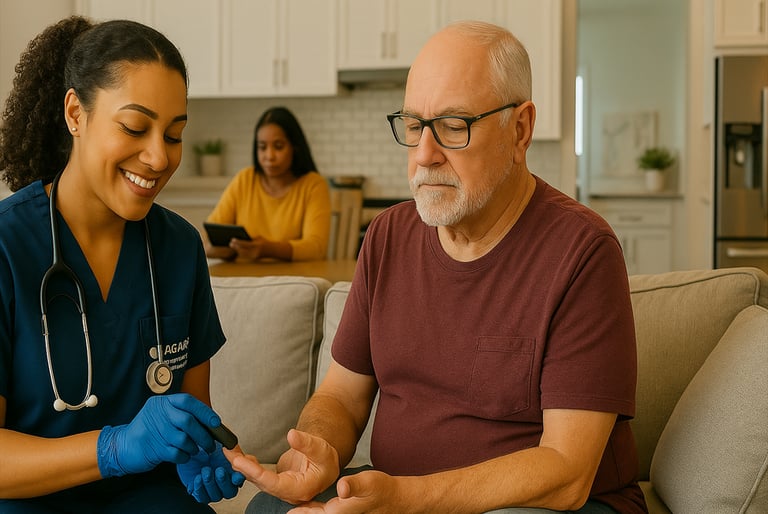
Glucose kit corner: meter or CGM, strips/sensors, lancets, alcohol wipes, batteries/charger, notepad or phone app.
Sharps safety: place used needles/lancets straight into an FDA‑cleared sharps container (pharmacies carry them). Guidance: https://www.fda.gov/medical-devices/consumer-products/safely-using-sharps-needles-and-syringes-home-work-and-travel
Go‑folder on the fridge: med list, allergies, diagnoses, clinician & pharmacy numbers, preferred hospital, latest A1C.
Healthy pantry swap: low‑ or no‑salt beans/broth/tomatoes; whole grains; frozen veggies without sauce; fruit packed in water.
2) The daily rhythm that actually works
Morning (5 minutes)
Check glucose (or review CGM trend).
Take medicines/insulin exactly as prescribed.
Quick foot check (skin, nails, blisters, redness, swelling). Foot care basics: https://www.niddk.nih.gov/health-information/diabetes/overview/preventing-problems/foot-problems
Evening (10 minutes)
Plan the next day’s meals using the Diabetes Plate Method (half non‑starchy veg, one‑quarter lean protein, one‑quarter carbs): https://diabetes.org/food-and-fitness/food/planning-meals/create-your-plate/
Read the Nutrition Facts label to compare carbs, fiber, and added sugars: https://www.fda.gov/food/nutrition-facts-label/how-understand-and-use-nutrition-facts-label
Tip: Consider a CGM if you use insulin—you’ll get trend arrows and alerts: https://www.niddk.nih.gov/health-information/diabetes/overview/managing-diabetes
3) Hypoglycemia (low blood sugar) — your 1‑minute plan
The 15‑15 rule: eat 15 g fast carbs, wait 15 minutes, recheck. Examples: 4 glucose tabs; ½ cup juice/regular soda; 1 tbsp honey.
Low blood glucose (ADA): https://diabetes.org/living-with-diabetes/hypoglycemia-low-blood-glucoseIf still <70 mg/dL, repeat 15‑15. Symptoms & steps: https://diabetes.org/living-with-diabetes/hypoglycemia-low-blood-glucose/symptoms-treatment
If severe (can’t swallow, confused, or unconscious): use glucagon if available and call 911. Severe low guidance: https://diabetes.org/living-with-diabetes/hypoglycemia-low-blood-glucose/severe
4) Sick‑day rules (copy this to your phone)
Check more often. Illness can push glucose up or down.
Hydrate and keep simple carbs (popsicles, juice, regular soda, gelatin) on hand if you’re at risk for lows.
When to call your clinician: vomiting/diarrhea >4–6 hours, high ketones, sustained high readings, or signs of dehydration.
Sick‑day planning (ADA): https://diabetes.org/getting-sick-with-diabetes/sick-days
CDC sick‑day tips: https://www.cdc.gov/diabetes/living-with/managing-sick-days.html
5) Food that loves you back (no math required)
Start with the Plate Method (visual guide, recipes): https://diabetes.org/food-and-fitness/food/planning-meals/create-your-plate/
Eat fiber first (veg/beans/whole grains) and pair carbs with protein to soften spikes.
Label refresher (carbs, fiber, sugars, %DV): https://www.fda.gov/food/nutrition-facts-label/how-understand-and-use-nutrition-facts-label
6) Foot care that prevents big problems
Every day: wash/dry well (not between toes), moisturize tops/soles, never go barefoot, and inspect with a mirror.
Call fast for breaks in skin, redness, warmth, swelling, drainage, or pain.
ADA foot‑care tips: https://diabetes.org/health-wellness/diabetes-and-your-feet/foot-care-tips
NIDDK foot problems overview: https://www.niddk.nih.gov/health-information/diabetes/overview/preventing-problems/foot-problems
7) Labs & targets (know your numbers)
A1C reflects your last ~3 months of glucose; targets are individualized—ask your clinician.
What A1C means (CDC): https://www.cdc.gov/diabetes/diabetes-testing/prediabetes-a1c-test.html
Testing overview: https://www.cdc.gov/diabetes/diabetes-testing/index.html
8) Travel with confidence (TSA‑friendly)
Keep insulin/supplies in carry‑on (not checked). Tell officers you’re carrying medical items.
Insulin & supplies: allowed in carry‑on with special instructions: https://www.tsa.gov/travel/security-screening/whatcanibring/medical
Insulin: https://www.tsa.gov/travel/security-screening/whatcanibring/items/insulin
Pumps/CGMs: https://www.tsa.gov/travel/security-screening/whatcanibring/items/insulin-pumps-and-glucose-monitors
Gel/ice packs: allowed for medical use: https://www.tsa.gov/travel/security-screening/whatcanibring/items/gel-ice-packs
ADA “What can I bring?”: https://diabetes.org/tools-support/know-your-rights/what-can-i-bring-with-me-on-plane
9) Insulin storage (and backup plan)
Store unopened insulin in the fridge (about 36–46°F / 2–8°C); protect from freezing, heat, and sun.
FDA storage basics: https://www.fda.gov/drugs/emergency-preparedness-drugs/information-regarding-insulin-storage-and-switching-between-products-emergency
CDC emergency storage tips: https://www.cdc.gov/diabetes/articles/managing-insulin-in-emergency.html
ADA storage & syringe safety: https://diabetes.org/health-wellness/medication/insulin-storage-and-syringe-safety
10) Georgia resources and real‑people support
Find a diabetes education (DSMES) program near you: https://www.cdc.gov/diabetes/education-support-programs/find-a-dsmes-program.html
Georgia DPH Diabetes hub: https://dph.georgia.gov/chronic-disease-prevention/diabetes
AFHCS can help with medication setup, CGM routines, foot‑care checks, sick‑day prep, and meal planning that fits your life: https://afhcs.com/services
11) Copy‑and‑save checklists
Daily 60‑second scan
Glucose checked/logged • Meds/insulin taken • Feet inspected • Meals planned using the Plate Method • Sharps safely contained
Sick‑day kit
Meter/CGM supplies • Simple carbs (juice, regular soda, gelatin) • Thermometer • Fluids/electrolytes • Ketone strips (if advised) • Clinician numbers
Travel pack
Double supplies in carry‑on • TSA Cares info (855‑787‑2227) • Gel ice pack • Written prescriptions • Insulin kept cool (not frozen)
How AFHCS can help (today)
Skilled Nursing, Personal Care, Companion Care, and CNA Services—from glucose checks and med setup to foot safety and meal planning: https://afhcs.com/services
Talk with us: https://afhcs.com/contact • Phone 470‑982‑CARE (2273) • Email corporate@afhcs.com
Resource hub with printable links: https://afhcs.com/resources
Works cited & helpful reading
ADA — Low blood glucose (15‑15 rule): https://diabetes.org/living-with-diabetes/hypoglycemia-low-blood-glucose
ADA — Hypoglycemia symptoms/treatment: https://diabetes.org/living-with-diabetes/hypoglycemia-low-blood-glucose/symptoms-treatment
ADA — Severe hypoglycemia (glucagon): https://diabetes.org/living-with-diabetes/hypoglycemia-low-blood-glucose/severe
CDC — A1C basics: https://www.cdc.gov/diabetes/diabetes-testing/prediabetes-a1c-test.html
CDC — Diabetes testing ranges: https://www.cdc.gov/diabetes/diabetes-testing/index.html
NIDDK — Managing diabetes (CGM overview): https://www.niddk.nih.gov/health-information/diabetes/overview/managing-diabetes
ADA — Create Your Plate: https://diabetes.org/food-and-fitness/food/planning-meals/create-your-plate/
FDA — How to use the Nutrition Facts label: https://www.fda.gov/food/nutrition-facts-label/how-understand-and-use-nutrition-facts-label
NIDDK — Foot problems & daily care: https://www.niddk.nih.gov/health-information/diabetes/overview/preventing-problems/foot-problems
FDA — Sharps safety (home/work/travel): https://www.fda.gov/medical-devices/consumer-products/safely-using-sharps-needles-and-syringes-home-work-and-travel
TSA — Medical items (diabetes supplies): https://www.tsa.gov/travel/security-screening/whatcanibring/medical
TSA — Insulin guidance: https://www.tsa.gov/travel/security-screening/whatcanibring/items/insulin
TSA — Pumps/CGMs: https://www.tsa.gov/travel/security-screening/whatcanibring/items/insulin-pumps-and-glucose-monitors
CDC — Managing insulin in an emergency: https://www.cdc.gov/diabetes/articles/managing-insulin-in-emergency.html
FDA — Insulin storage basics (emergencies): https://www.fda.gov/drugs/emergency-preparedness-drugs/information-regarding-insulin-storage-and-switching-between-products-emergency
CDC — Find a DSMES program: https://www.cdc.gov/diabetes/education-support-programs/find-a-dsmes-program.html
Georgia DPH — Diabetes: https://dph.georgia.gov/chronic-disease-prevention/diabetes
Disclaimer: This guide is educational and not a substitute for personal medical advice. Always follow your clinician’s instructions for medications, glucose targets, and when to call.
corporate@afhcs.com
470-982-CARE (2273)
Follow Us
6470 E Johns Crossing Ste 100
Johns Creek, GA 30097 USA
Fax: (470) 819-5215
Contact Us
Follow us on social media to get the latest updates about our services and care packages.